HazCom in 2026: A Midyear Review for Washington Employers
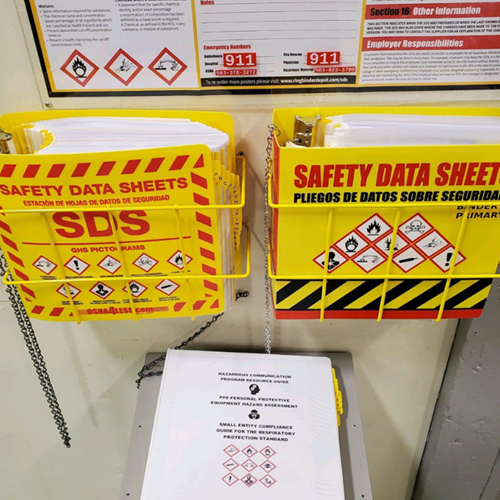
Washington employers should use the summer of 2026 to bring their hazard communication program in line with OSHA's updated HazCom standard. A complete midyear review covers five things: a current chemical inventory, updated safety data sheets, correct secondary-container labels, a revised written program, and retraining for any newly classified hazards. Under Washington's rule (WAC 296-901), the employer deadline for substances is July 20, 2026; federal OSHA extended its parallel employer deadline to November 20, 2026, and mixtures follow in January 2028. Because Washington runs its own OSHA-approved program, confirm the date that applies to you with L&I and do not wait to start.
What changed in the HazCom update?
OSHA updated the Hazard Communication Standard to align with the 7th revision of the Globally Harmonized System (GHS Revision 7), which changes how chemicals are classified, what goes on labels, and how safety data sheets are formatted. Washington adopted the same alignment in WAC 296-901. In practice that means some chemicals move into new hazard categories, labels carry updated elements, and SDS sections may read differently than the versions in your binder. If your written program has not been touched since the 2012 GHS rollout, it is now out of date.
When is the HazCom deadline for Washington employers?
For substances, Washington's rule sets the employer deadline at July 20, 2026, while federal OSHA extended its matching employer deadline to November 20, 2026; for mixtures, employers have until January 19, 2028. Manufacturers, importers, and distributors had an earlier substance deadline in May 2026. The two employer dates exist because Washington operates its own workplace safety program through L&I and does not always move on the exact federal timeline. The safe approach is to be ready by the earlier date rather than bet on the later one, and to confirm your specific obligation with L&I.
What should a midyear HazCom review cover?
A useful review walks your program end to end, from the chemicals on your shelves to the training records in your file. Work through these in order:
- Rebuild your chemical inventory so it matches what is actually on site right now.
- Confirm you have a current safety data sheet for every hazardous chemical, and that employees can get to them.
- Check that every secondary container (including spray bottles and transfer jugs) is labeled the moment product goes into it.
- Update your written hazard communication program to reflect the current rule and your current operation.
- Refresh your training materials for the new label elements and hazard classes.
- Document that training happened, because in an inspection, training you cannot prove is training you did not do.
What are the most common HazCom gaps?
The gaps almost always show up in the same places: missing or outdated SDSs, unlabeled secondary containers, a written program nobody has opened in years, and no records proving employees were trained. Andrew Lange, A/F's safety lead, sees the same scene often: a spotless SDS station on the wall that nobody has updated, and a row of spray bottles under the sink with no labels at all. Neither one is hard to fix, but both are easy citations, and more importantly, both leave workers guessing about what they are handling.
Real talk: a compliant binder is not a trained crew
You can have a perfect written program and still fail the part that matters. HazCom is not about the binder passing an inspection, it is about the person mixing chemicals knowing what is in the bottle and what to do if it ends up on their skin. If your team cannot read a label, find an SDS, and explain the hazards of the products they use every day, the paperwork is not protecting anyone. Fix the knowledge first, then make sure the documentation backs it up.
Get your HazCom program current before the deadline
A/F Business Solutions builds and updates written HazCom programs, SDS organization, and labeling systems for Yakima and Central Washington employers, and delivers the employee training the rule requires, with records to prove it. For related summer risks, read our guide to heat illness prevention for Washington employers and make sure your team is ready for an emergency with CPR, First Aid, and AED training, or work through the monthly workplace safety checklist. To get your program reviewed before the deadline, call Andrew for safety at (509) 654-0332.
Frequently asked questions
When do Washington employers have to update their HazCom program?
Washington's rule sets the employer deadline for substances at July 20, 2026, while federal OSHA extended its parallel deadline to November 20, 2026. For mixtures, employers have until January 19, 2028. Confirm the date that applies to your workplace with L&I.
What is a safety data sheet?
A safety data sheet (SDS) is the standardized document that describes a chemical's hazards, safe handling, and emergency measures. Employers must keep a current SDS for every hazardous chemical on site and make them accessible to employees.
Do spray bottles and other secondary containers need labels?
Yes. Any container a chemical is transferred into must be labeled as soon as it is filled, unless the employee who fills it uses it entirely within their own shift.
Who needs hazard communication training?
Every employee who works with or may be exposed to hazardous chemicals needs training, at initial assignment and whenever a new chemical hazard is introduced to their work area.
Is HazCom a commonly cited standard?
Yes. Hazard communication is consistently one of the most frequently cited workplace safety standards, and violations carry real financial penalties, which is why keeping the program current matters.