
Safety Training & Certification
Forklift and Powered Industrial Truck Certification in Yakima and Central Washington
OSHA requires both classroom instruction and a hands-on evaluation performed on the equipment your operators actually run. We come to your facility and certify in your own aisles and terrain, documenting every operator for PIT equipment types 1 through 7 and aerial work platforms such as scissor lifts and boom lifts.
Trusted by crews across Washington









Overview
What this training delivers
Forklift and powered industrial truck certification is the OSHA-required training for anyone who operates a forklift, pallet jack, reach truck or telehandler at work. OSHA requires both formal instruction and a hands-on evaluation proving each operator can safely run the equipment they actually use.
This training is for new hires, experienced operators due for renewal, and any business that wants to cut accidents, injuries and liability. We come to your facility and complete the practical evaluation on your machines, in your aisles, with your real hazards.
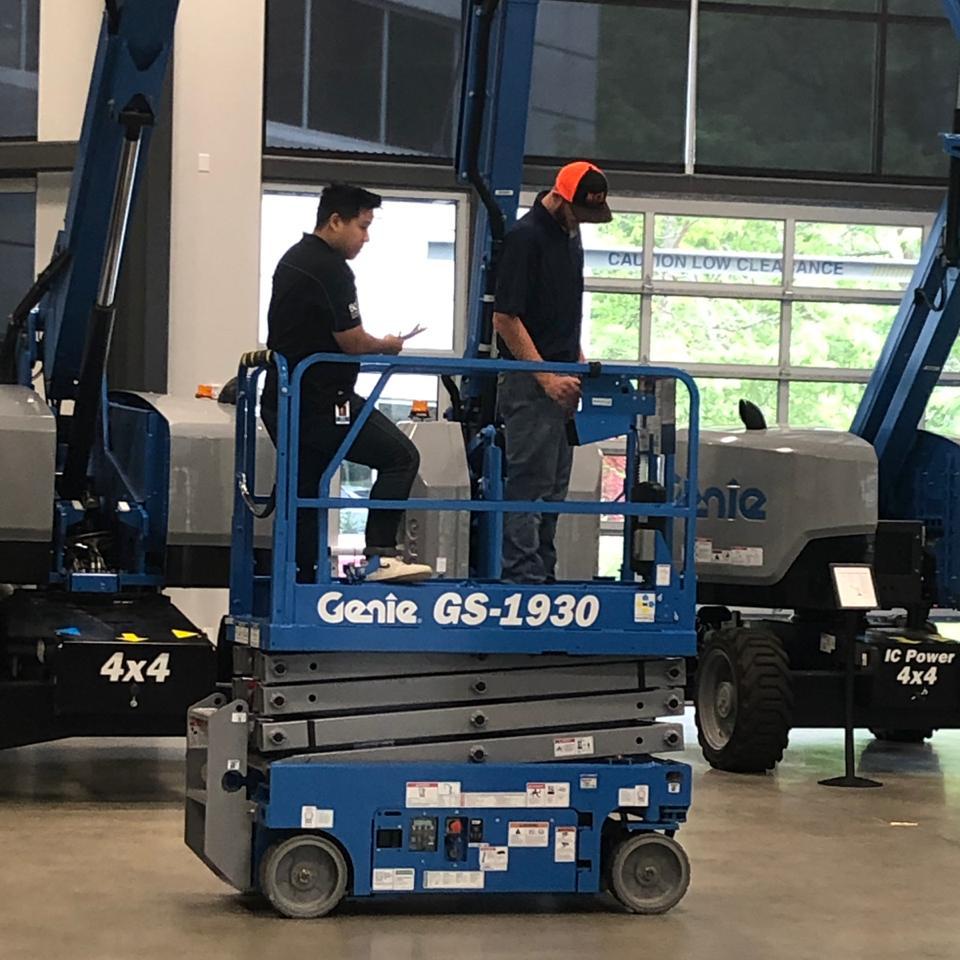
We also certify aerial lifts: scissor lifts, boom lifts, articulating lifts and vehicle-mounted platforms, which fall under their own OSHA and Washington rules.
What's covered
What your crew will learn
Classroom instruction covers the why from a certified instructor. The hands-on portion proves your crew can do the work safely.
Classroom Topics
Forklift and powered industrial truck
- OSHA requirements and operator responsibilities
- Equipment types: counterbalance, reach truck, pallet jack, telehandler
- Pre-operation inspections and defect identification
- Load charts, capacity and center of gravity
- The stability triangle and tip-over prevention
- Safe travel: speed, visibility, ramps and docks
- Pedestrian safety and aisle management
- Stacking, unstacking and load handling
- Battery and propane safety
- Parking, shutdown and securing equipment
Aerial and manlift
- Lift types: scissor, boom, articulating and telescopic
- Fall protection: harness, lanyard and anchor points
- Stability, leveling and outriggers
- Electrical hazards and safe approach distances
- Weather and surface conditions
- Emergency descent procedures
Hands-On Practical
- Full pre-use inspection on your actual equipment
- Starting, stopping and maneuvering in real workplace conditions
- Lifting, lowering and tilting with live loads
- Traveling with loads: forward, reverse, ramps and tight aisles
- Dock work and trailer entry where applicable
- Stacking and unstacking pallets or materials
- Aerial platform operation: raising, lowering, rotating, and safe positioning near edges and structures
- Emergency lowering and rescue procedures
- Documented operator performance evaluation per OSHA and L&I
Who needs this
Who is this training for
If you touch a forklift at work, you must be certified. If your feet leave the ground on powered equipment, you must be trained.
- Warehousing and distribution: shipping and receiving, order pickers, distribution center staff
- Manufacturing and fabrication: machine operators, material handlers, maintenance
- Construction: laborers using telehandlers, and any trade working from a lift
- Agriculture and food processing: equipment operators and yard crews
- Retail and facilities: back-of-house staff, utility and maintenance crews
- Trades working at height: HVAC, electrical, telecom, signage, painting and arborists
Certification
Certification details
A card that means something. Issued by a body that inspectors recognize and valid for a period that keeps you ahead of the deadline.
Certification Issued
PIT operator certification for equipment types 1 through 7, plus aerial work platform certification for scissor lifts and boom lifts
Issuing Body
A/F Business Solutions, evaluated to OSHA 1910.178, 1926.602, 1926.453 and 1910.67, and WAC 296-863 and 296-869
Validity Period
3 years
What They Receive
- Wallet card and digital record for employer files
- Documented hands-on evaluation performed on your actual equipment
- Operator training file that satisfies OSHA's proof-of-competency requirement
- Annual practical evaluations available separately from full certification
Recertification Triggers
- Every three years
- Immediately after any incident, near miss or unsafe operation
- When an operator is observed operating unsafely
- When switching to a different class or type of truck or lift
- When the workplace changes: new equipment, new hazards, new layout
Process
How it works
We come to your facility. Here is what to plan for, and what we bring with us.
Time Required
Forklift: 1.5 to 2 hours classroom plus 10 to 15 minutes per operator. Aerial lift: 1 to 1.5 hours classroom plus 10 to 15 minutes per operator.
Class Size
No limit. Hands-on evaluations run one operator at a time for OSHA conformance, and large groups run in waves to minimize downtime.
Prerequisites
Operators must be 18 or older and able to operate controls safely. No prior experience required.
Employer Provides
- A working forklift or aerial lift. If you do not have company equipment, we can rent and transport it to you under contract.
- A safe area with room to run the hands-on evaluation: warehouse aisle, yard space or loading dock
- Site-specific PPE your employees normally use
- A supervisor or lead who can confirm site-specific hazards
What We Bring
- All classroom materials
- Operator evaluation forms
- Certification cards and digital records
- A training program tailored to your equipment and your hazards
Why A/F Business Solutions
Trained by someone who has done the work, not just read the standard.

Most low-cost trainers only read OSHA slides and hand out cards. We have actually operated forklifts, telehandlers, scissor lifts and boom lifts in real warehouses, lumber yards, construction sites and high-hazard environments across Central Washington. Your team learns practical, real-world skills, not textbook theory.
We come directly to your facility, certify operators on your equipment, and tailor the hands-on evaluation to your actual hazards, workflow and site conditions. After running well over a thousand operators through this training at operations like International Paper, Genie, Orchard-Rite and GFI Hay Processing, we know how to make it fast, clear and confidence-building while keeping you fully compliant with OSHA and Washington L&I.
Get on the schedule
Request training
Fill out the form and Andrew will respond within 1 business day. Fields with an (*) asterisk are required to submit the form.
Common questions Answered
Questions about our training
Straight answers to the questions we hear most from foremen and safety managers.
No limit. We have run well over a thousand operators through this training. Classroom runs as a group, and hands-on evaluations run one operator at a time as OSHA requires. Large groups run in waves to keep your downtime to a minimum.
Yes. We offer the annual practical evaluation on its own, separate from full certification, for operators who are already certified and current.
Classes 1 through 7 including telehandler, plus skid steer, front end loader, dozer and mini excavator. We also certify aerial and manlift equipment: scissor, boom, articulating and telescopic.
Yes, and that is the point. OSHA requires the hands-on evaluation to happen on the equipment your operators actually use. We come to you and evaluate on your machines, in your aisles, with your real hazards. If you do not have company equipment, we can rent and transport it to you under contract.
Three years, or sooner if it is triggered by an incident, a near miss, observed unsafe operation, or a change to a different class or type of equipment. Any of those requires a new evaluation before the three years is up.